Differences and Functional Analysis of White Noise and Pink Noise Testing
White Noise vs. Pink Noise: Test Differences and Functional Analysis
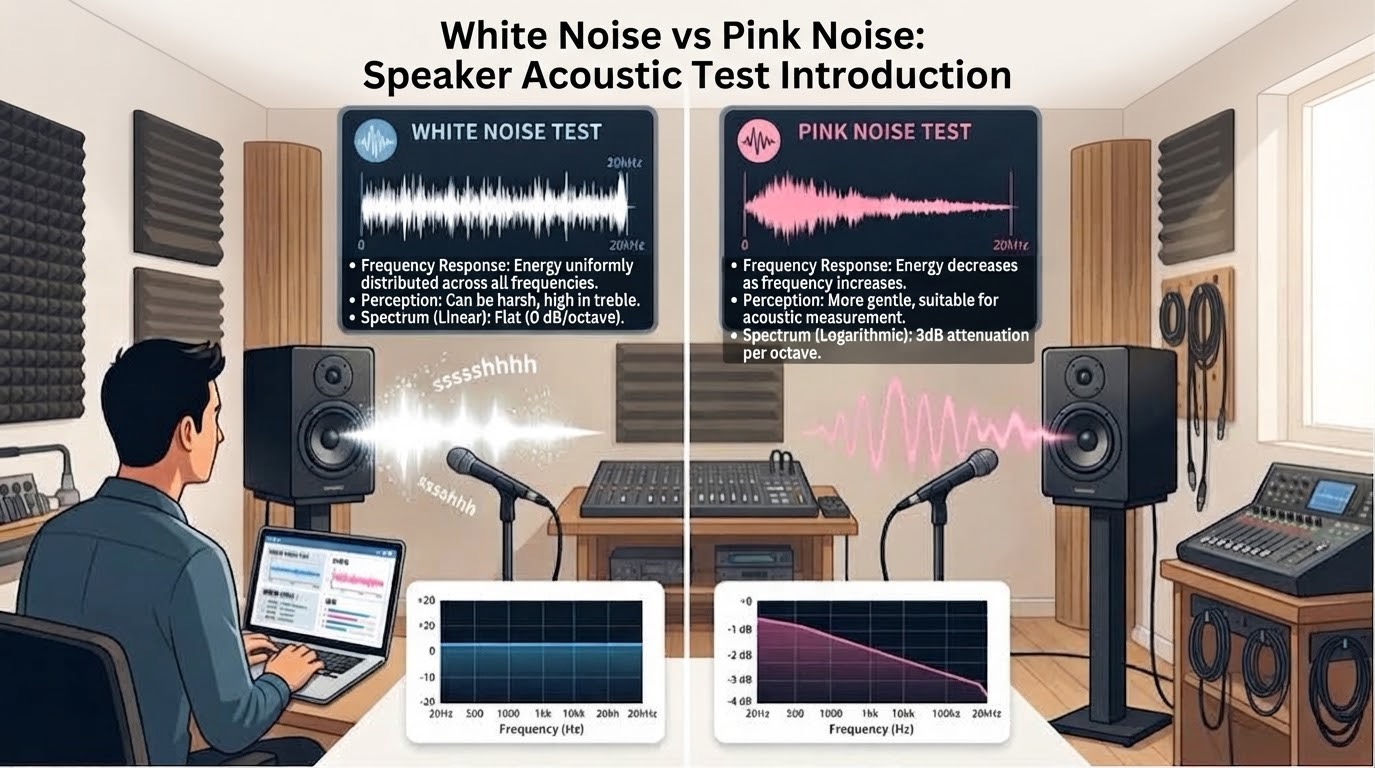
The fundamental difference between white noise and pink noise lies in how their energy is distributed across frequencies. White noise has equal energy per 1 Hz bandwidth, whereas pink noise has equal total energy per octave. Consequently, pink noise contains relatively more low-frequency energy, aligning more closely with how the human ear perceives frequencies by octaves, making it the preferred choice for speaker and sound field measurements.
While pink noise carries equal energy in every octave, white noise—despite having equal energy per Hz—accumulates higher total energy in higher octave bands when analyzed on an octave scale, as bandwidth increases with frequency.
Why Pink Noise is Commonly Used in Speaker Testing
Pink noise is a standard signal for audio system tuning and acoustic measurement for several key reasons:
-
Matches Human Hearing Perception: The human ear perceives pitch logarithmically. For example, the interval from 100 Hz to 200 Hz represents one octave, just as 1 kHz to 2 kHz does. Because pink noise provides nearly equal energy per octave, it serves as a better baseline for subjective listening tests and Real-Time Analyzer (RTA) measurements.
-
Ideal for Observing System Frequency Response: When driving a speaker with pink noise and using an RTA or measurement microphone, it is easy to visually identify peak responses, dips, resonances, or crossover transition issues across low, mid, and high frequencies.
-
Effective for EQ and Room Tuning: In PA systems, conference rooms, showrooms, home theaters, or speaker audition rooms, pink noise paired with an RTA allows engineers to evaluate the acoustic field and adjust EQs, DSPs, crossovers, or speaker positioning accordingly.
-
More Representative Low-Frequency Loading: Containing substantial mid-to-low frequency energy, pink noise effectively drives woofers or full-range drivers to realistic displacement and thermal load levels. When using it for endurance or power handling tests, appropriate parameters—such as voltage, crest factor, bandwidth, and duration—must be configured to avoid misjudgment or driver damage.
Test Applications Better Suited for White Noise
White noise is not inferior; rather, it serves different specific purposes:
-
Electronic Circuit and Signal Chain Testing: It is ideal for evaluating the frequency response, noise floor, and noise characteristics of preamps, power amplifiers, DSPs, ADCs/DACs, filters, or signal transmission paths.
-
High-Frequency System Inspection: Because white noise accumulates relatively higher energy in upper octave or 1/3-octave bands, it helps highlight performance issues in tweeters, high-frequency EQ bands, filters, and high-frequency distortion.
-
Masking Background Sound: White noise can mask irregular environmental background noise, such as office chatter, HVAC systems, or equipment hums. However, due to its prominent high-frequency "hissing," listening to it for extended periods may not be comfortable for everyone.
Practical Example
Suppose a 20 Hz–20 kHz test signal is used to measure a Bluetooth speaker:
-
Using White Noise: Energy per 1 Hz is uniform. However, the octave from 10 kHz to 20 kHz spans a bandwidth of 10 kHz, accumulating far more total energy than the 100 Hz bandwidth of the 100 Hz–200 Hz octave. As a result, the measurement system will display significantly boosted energy in the high-frequency range.
-
Using Pink Noise: Each octave—such as 100 Hz–200 Hz, 1 kHz–2 kHz, and 10 kHz–20 kHz—carries roughly equal total energy. When observing the speaker's output on an RTA, it becomes much easier to identify actual low-frequency roll-off, midrange emphasis, or high-frequency attenuation.