
Speaker Enclosure Design: The Core Differences and Functions Between Bass Reflex Ports and Passive Radiators
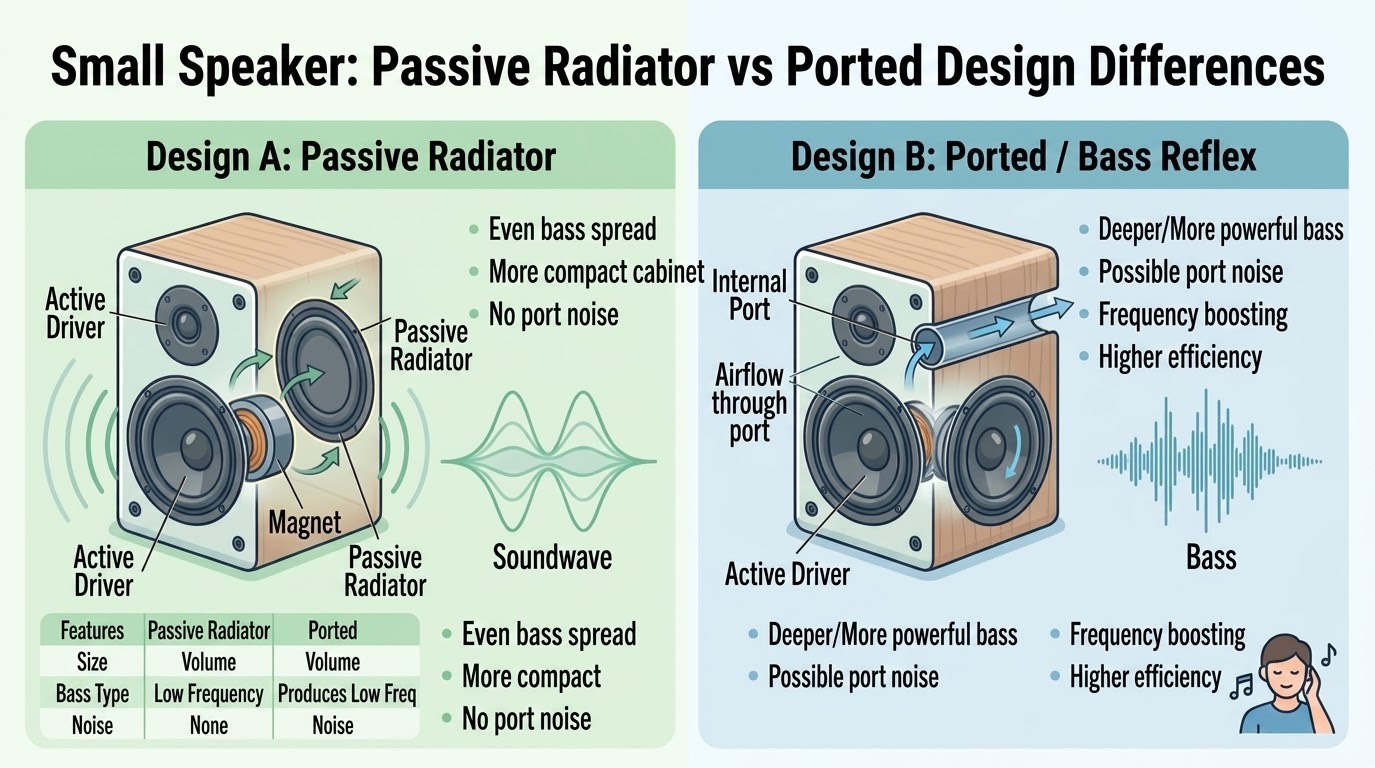
Speaker Design: Key Differences and Functions of Ports and Passive Radiators
In speaker enclosure low-frequency design, both ports and passive radiators are used to utilize the sound waves generated from the back of the speaker driver, extending low-frequency response and boosting output within specific low-frequency ranges. However, their operating components differ: ports rely on the resonance of the air column inside the tube, while passive radiators rely on the vibration of a diaphragm mass and surround system without a magnetic circuit or voice coil. Both can be viewed as different implementations of a bass-reflex system.
Basic Principles
-
Ported Enclosures (Bass-Reflex) Ports are also commonly called bass-reflex tubes, inverted phase tubes, or bass ports. The port diameter, port length, and enclosure volume together form a Helmholtz resonator.
When the woofer cone moves inward, the air inside the enclosure is compressed. Near the designed tuning frequency, the air column inside the port resonates and radiates acoustic energy outward through the port opening. At this point, the low-frequency output from the port aligns close to the same phase as the sound from the front of the driver, thereby reinforcing low-frequency response and increasing efficiency.
The tuning frequency of a port is influenced by the following factors:
-
Effective enclosure volume
-
Port cross-sectional area or diameter
-
Effective port length
-
Driver T/S parameters
-
Damping material, air leakage, end corrections, and actual enclosure geometry
Generally, a longer port or a smaller port cross-sectional area lowers the tuning frequency. However, actual design requires simulation, measurement, and listening adjustments in conjunction with the driver and enclosure volume, rather than relying solely on a single formula.
-
Passive Radiator Enclosures Passive radiators are also known as passive cones, passive diaphragms, or passive radiators. Their appearance closely resembles a standard speaker driver, but they lack a voice coil, magnet, or electrical input; they are driven entirely by the air pressure changes inside the enclosure.
As the woofer operates, it alters internal enclosure pressure, causing the passive radiator to move back and forth. By adjusting the passive radiator's effective moving mass, diaphragm surface area, surround compliance, and enclosure volume, the system can be tuned to the target resonant frequency. Its function mirrors that of a port: providing effective low-frequency output near the tuning frequency while reducing the displacement demands on the active driver around that band.
Passive radiators are commonly found in compact Bluetooth speakers, portable bass products, ultra-thin enclosures, and products where the cabinet size is too small to fit a sufficiently long port.